We will start this out by posing a question. I'm sure you've heard of insider trading before, but are you honestly aware of what it is? We all know Martha Stewart got herself in deep shit over it. She's not the only one either. You may never have heard of Ivan Boesky but I'm fairly sure you may have heard of Gordon Gekko. The latter is a fictional character based on the former, who actually gave the 'Greed is Good' speech at Berkeley in 1986 (the balls on that guy).
So people get busted for this thing but what exactly is it? To break it down simply insider trading is making purchases or selling stock with the foreknowledge that it is going to rise or fall based on major decisions. Think back a bit. Remember the movie Trading Places? The one with Eddie Murphy and Dan Aykroyd? At the climax of the movie, all of the stock traders are waiting breathlessly for a government agency's report. Insider trading would be one of them getting the report and making trade decisions based on it before anyone else was capable of it. It is a practice that is considered highly illegal in most countries and is able to be applied to even the extremely wealthy (George Soros for example, who's net worth is north of $22 billion...with a B).
So, it's an unfair and illegal practice that sends people to jail or costs them lots and lots of money. But guess what? Congress is saying "We're better than you" in all but word.
Think about this. You're a congressional representative. You're working in a committee on the environmental effects of oil drilling on the scrub jay population in Florida. You know this committee came into being because the XYZ Oil Corporation has been petitioning the EPA for permission to drill there. The decision of this committee will affect the oil company either positively or negatively. Being on the front line of the conversation you can gauge which way the decision will go. You then buy (or short) stocks appropriately. No one else (save those on the committee) have this information. This is insider trading but guess what? For you, it's perfectly legitimate.
This is because Congress apparently feels that they are above the rules that they create for the rest of you plebeians. In fact, there is a bill in Congress right now that is aimed directly at stopping this sort of thing, but guess what? It's not going to go anywhere. For those that are curious it is called the Stop Trading on Congressional Knowledge (STOCK) Act. And fuck does Congress love their acronyms, or what? The bill was proposed by Senator Bachus. This name may mean nothing to you, but irony of ironies, he's been caught doing the insider trading thing before. What's good for the goose?
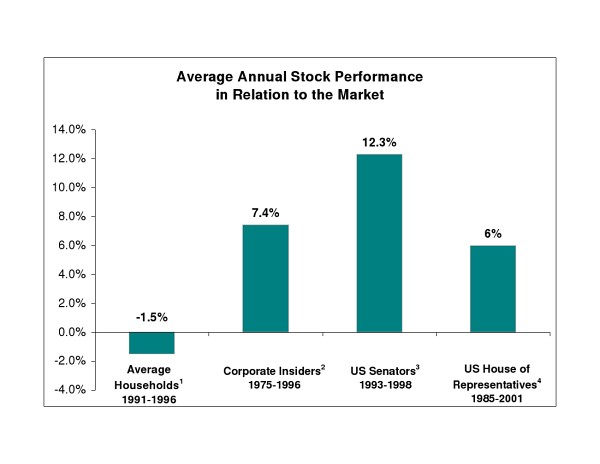
How well do they do with this whole insider trading thing? Well, here's a little graph (from the Daily Kos) showing the average performance of portfolios for the typical citizen, inside traders, the Senate and the House.
Speaking of the news, I doubt you could have missed catching at least one report on Anonymous. Now, think about the report for a moment. Did the report classify them as a 'rogue hacker collective', 'hacktivists', 'online hacker group', 'internet terrorists' or any of a broad range of tags intended to terrify and make you think that they were going to destroy the world as we know it? They have been in the news a lot lately for crashing the websites of many, many places. Far too many for me to bother listing here but the most popular so far seems to have been the FBI home page.
Now, maybe this is because the culture over all still doesn't understand computers or the internet, or they think that anything done online is considered hacking. A lot of this is perpetuated by the news and, if you downloaded Kazaa or LimeWire and thought you were a hacker, just shoot yourself.
A little straight talk here. What they have been doing is called a Distributed Denial of Service (DDoS) attack. This, is not hacking. Here's how it works. You go to a web page, your browser places a call-request to the server which then responds by sending you the page. A DDoS attack uses multiple computers (it doesn't matter how many, just more than one, hence the 'Distributed' part of the term) to make many many thousands of call-requests to the server. This overburdens the server and eventually causes it to lock up (kind of like your old Windows XP computer used to do all the time when you've left it running for too long. Also look up Blue Screen of Death or BSoD). When the server locks up, it can no longer deliver the web page to other call requests (thus Denying the Service to other users). Fuck, geeks love acronyms as much as Congress.
This sort of attack only requires a simple program to run. Using one of these does not make you a hacker. This makes you, at best, what is commonly referred to as a 'skiddie' or 'script kiddie'. Timing out a server isn't even close to actual hacking. If you really want to know how hackers operate, then I suggest going over to this site and running through their challenges (and breathe easy, it's not actually illegal on that site).
Now, the big question. Does Anonymous hack? Indeed they do. But here's a logic loop for you. All hackers are not part of Anonymous. Not all of Anonymous are hackers. The two are not synonymous in any way, despite what the news might have you believe.
Here is what I've been able to gather about the group. They are a group of idealists. There is no uniform leadership, but there are common ideals that make their actions distinct. They hold on to the idea that the internet should remain free of control from any intervention by any world government. They maintain that freedom of speech is an inalienable right. They hold that information should be free (the unrestrained sharing of information). They have never engaged in hacking with the intent of theft (monetary theft, secrets are fair game, see the previous point). Finally, they believe in doing some things because it is amusing (for teh lulz).
I maintain the position that their actions, mischievous (there's another 'mis' for you) as they may be and potentially destructive as they may be, qualify as the internet equivalent of a protest, and therefore is covered by the First Amendment. Does this mean they are right? No. But as I've said before, right generally doesn't matter when it comes to the maintaining of freedom. If a group of Neo-Nazi's decide to hold a rally and spout their ideology, no matter how wrong, asinine, stupid, or even dangerous it might be, then I say they damn well have that right. Let me be very clear here. I am not espousing that I hold any of that ideology myself, but I am saying I maintain that everyone's rights are equal. From the most racist bigoted backwoods rednecked son of a bitch, to the most high brow, intellectual, do-nothing hippie, everyone is afforded the same rights.
Let's face it. Disrupting business as usual is the entire purpose of a protest. If it did not cause some sort of disruption it would not be noticed. If it isn't noticed, then no awareness is brought to the forefront. The protest becomes ineffective and so, a new method has to be found. Disruption of internet services via taking down a website, is no different than having a massive group of people standing in front of a particular building with signs and chanting slogans. The effect is exactly the same, only no one has to freeze or burn. The fact that they can do this to multiple locations at once is again, no different than having multiple crowds blocking multiple places. I happen to agree with their particular ideology, but as I stated in the last paragraph, that makes no difference to the application of rights.
"The most valuable commodity I know of is information" -- Gordon Gekko, 'Wall Street' (1987)


No comments:
Post a Comment